Email Discipleship Versus Church Apps for Churches
October 30, 2026
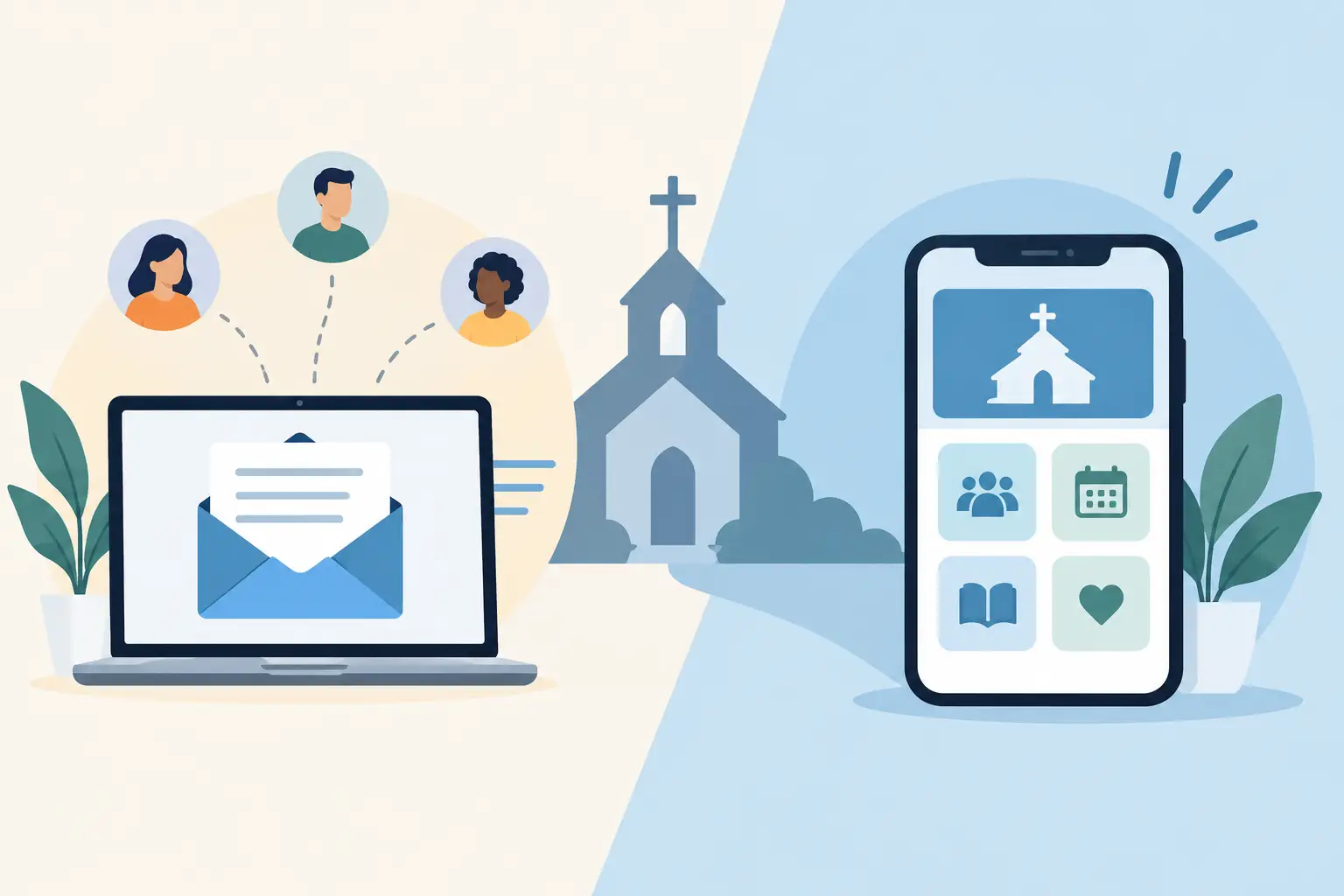
A sermon can be faithfully preached on Sunday and still be hard to recall by Tuesday morning. That is not a failure of the preacher or the congregation. It is the reality of crowded weeks, family needs, work pressure, and a hundred competing messages. The question behind email discipleship versus church apps is not which technology is more impressive. It is which channel helps your people carry God’s Word into ordinary life.
For many churches, the answer will not be absolute. An app can serve a real purpose. Email can be remarkably effective. But when your goal is consistent, sermon-rooted discipleship from Monday through Friday, the best choice often comes down to reach, habit, and the amount of friction your ministry team can honestly sustain.
Email discipleship versus church apps: start with behavior
Church leaders sometimes evaluate technology by features first. Does it have push notifications? Can it host sermons? Does it offer giving, event registration, or prayer requests? Those are fair questions, but discipleship begins with a more basic one: Where will people actually see and use this?
Most adults already check email as part of their normal day. They use it for work, family logistics, receipts, school updates, medical information, and church communication. A devotional email does not require them to remember a new login, find an app icon, or make space on a crowded home screen. It meets them in a familiar place.
That familiarity matters because spiritual formation is built through repeated attention, not a one-time download. A short weekday reflection tied to Sunday’s sermon can become a dependable rhythm: read Scripture, consider one clear truth, take one practical step, and perhaps discuss it with a spouse, friend, or small group.
Church apps ask for a different kind of commitment. Members need to download the app, allow notifications, remember why it is worth opening, and return after the first week. Some will. Your highly connected members may appreciate having sermons, events, giving, and group resources in one place. Yet adoption often drops after the launch excitement fades, especially when the app does not become part of a person’s existing routine.
This does not make apps bad. It simply means an app is a destination, while email can be a gentle invitation that arrives where people already are.
What each channel does well
A church app is often strongest when your church needs a central hub. It can bring several ministry functions together: a sermon archive, calendar, mobile giving, volunteer scheduling, group directories, registration forms, and resource libraries. For a larger church with staff capacity and a congregation accustomed to digital tools, that kind of organization can be genuinely helpful.
Apps can also work well for people who are already deeply involved. A small-group leader looking for curriculum, a volunteer checking a schedule, or a member watching a past sermon may benefit from one dedicated place to go. If your church has an active app community, it can support ministry well.
Email is strongest when the goal is simple, regular engagement. A daily devotional email can place a meaningful next step in front of members without asking them to search for it. It also gives pastors and ministry teams a clear format for extending the sermon: one passage, one reflection, one action step, and one question worth carrying through the day.
That focus is a strength. Your congregation does not need another content library to feel discipled. They need help returning to Scripture and applying what they heard on Sunday.
Email also tends to be easier to share. A member can forward a reflection to a friend, reply with a prayer request, or bring the day’s question into a conversation. Those are small actions, but they create room for relationship. Discipleship is not measured by clicks alone.
The hidden cost is not always the monthly fee
When comparing platforms, it is easy to focus on software pricing. The larger cost is often staff attention.
An app needs ongoing care to remain useful. Events need updating. Content needs refreshing. Notifications need planning. Members need help when they cannot log in or do not know where to find something. If the app is only updated when a major event is coming, people learn that there is little reason to open it between announcements.
Email needs care too, but its workflow can be much lighter when it is built around the sermon you are already preparing. The sermon becomes the source material for the week rather than disappearing after Sunday. That is a more realistic system for a solo pastor, a small staff, or a ministry team that does not have a dedicated communications person.
This is where a focused tool can help. Sermary turns one weekly sermon into a structured five-day devotional plan with Scripture, reflections, action steps, and small-group questions, then schedules it for daily email delivery. It is built around the work pastors are already doing, not around creating more content for content’s sake.
The right question is not, “Can our church afford an app?” It is, “Can we keep this channel spiritually useful every week without exhausting our team?” Honest answers will lead to better stewardship.
Notifications are not the same as attention
Push notifications sound like a clear advantage for apps. They can be useful for last-minute changes, event reminders, or time-sensitive ministry needs. But a notification is competing with every other alert on a phone. Many people mute them. Others see them at the wrong moment and forget them immediately.
Email is not guaranteed attention either. Subject lines matter. Sending too often without clear value can train people to ignore messages. But a consistent devotional email has a different posture than a promotional blast. It can arrive at the same time each morning with a recognizable purpose: help me remember and respond to God’s Word.
The difference is trust. Members will make room for communication that serves them rather than simply asks something of them.
Keep the email brief enough to read before work, during a lunch break, or while waiting in the carpool line. Avoid trying to restate the entire sermon. A good weekday devotional creates a single point of reflection and leaves room for prayer.
When a church app is the better choice
There are situations where an app should be part of your ministry plan. If you have a large, digitally engaged congregation, multiple campuses, frequent registrations, complex volunteer coordination, or a real need for a centralized member experience, an app may be worth the investment.
Even then, it does not have to carry the full discipleship burden. Your app can be the home base while email becomes the weekly pathway that brings people back to Scripture. An email can point members to a group resource in the app when needed, but it should still stand on its own if they never tap another button.
For smaller churches, the decision is often clearer. If you are choosing between launching an app that may require steady maintenance and sending a sermon-based devotional that reaches people in an existing habit, email is usually the more practical place to begin.
Build for the Monday morning test
Before choosing a platform, picture a church member at 7:15 on Monday morning. They are preparing for work, getting children ready, or trying to collect their thoughts before the day begins. What will help them take one faithful step?
Probably not a feature-rich platform they need to remember to open. More likely, it is a clear and caring message waiting in their inbox: a Scripture passage, a reminder from yesterday’s sermon, and one question that follows them into the day.
Choose the channel your church can use faithfully, not the one that looks most advanced in a demonstration. Sunday’s message deserves more than a brief moment of attention. Give your people a simple way to keep walking with it when Monday arrives.